Transformative, not repetitive
Unlike many current courses that focus on theory and repeat information you already know, our program stands out for being transformative, because it gives you a tool that is directly applicable to your patients.

Designed to give you a tool for understanding the unique needs of your patients and tailoring their nutrition plan to each individual.
 100% online, at your own pace
Unlike many current courses that focus on theory and repeat information you already know, our program stands out for being transformative, because it gives you a tool that is directly applicable to your patients.
The goal is to give you information based on up-to-date scientific evidence and our years of experience, breaking with several current paradigms, which will be useful to you in clinical practice.
It is designed for Health Professionals who want to specialize in the study of Body Composition and Nutritional Diagnosis through the ENFA® Method. A unique and valuable tool that you will be able to apply with your patients in both physiological and pathological situations.
Here you'll find the most frequently asked questions about applying the ENFA Method
Structural weight is the sum of all the masses (fat, skeletal, muscle and visceral). When actual weight exceeds structural weight, this remainder, which cannot be attributed to any of the masses, corresponds to fluid (Residual Mass). This retention is almost nil in children or adolescents, but it is acceptable and variable in women during the second phase of the menstrual cycle and usually reaches high values during pregnancy. In these circumstances, the residual mass includes the fetus, the placenta, the amniotic fluid, the increased plasma volume and edema.
In males it is normal to find a residual mass of 2 to 4 kg.
In women it tends to be highly variable, from a few grams up to 7-8 kg.
In pathological conditions it is found to be elevated in congestive heart failure, kidney disease, ascitic-edematous syndrome and other causes of edema. It may also be increased by the use of drugs such as anabolic steroids, creatine, corticosteroids, anovulatory agents, etc.
No. When this happens, you should assume that some measurement was taken incorrectly or that an incorrect measurement was entered into the program. Body weight must be checked again (calibrating the scale properly). Check that the stadiometer measures correctly and repeat the skinfold measurements. Fat is the main source of error (5%); errors are rare when measuring bone breadths and girths (1%).
The skeleton is an important reference, since under normal conditions muscle mass and fat mass adjust to it. It grows in a similar way in both sexes up to age 14. After that, in women it remains stable while in men it keeps growing until around age 25. For this reason, boys and girls can compete together up to age 14.
Since muscle mass increases in relation to the weight of the skeleton, after age 14 men will have more muscle mass and therefore greater strength. This is a parameter to bear in mind when selecting elite competition teams, where height and strength play an important role.
The absolute value of muscle mass means nothing, nor does its percentage relative to body weight, since the latter may be increased by a high residual mass.
When muscle mass is decreased in relation to the skeleton (protein reserve), protein malnutrition becomes evident (either moderate or severe). This decrease may be caused by unbalanced diets with insufficient protein intake or with insufficient intake of high-biological-value protein. Decreased protein reserves are also seen in clinical conditions that involve protein catabolism. On the other hand, muscle mass may be increased when regular physical activity is combined with an appropriate nutrition plan. This generally occurs in people with a small skeleton.
Visceral mass is contained within a bony and muscular cage that can only vary to a certain extent through an increase or forward projection of the abdomen. This increase may correspond to hepatomegaly, splenomegaly, abdominal tumors, ascites and pregnancy.
The Protein Reserve is the ratio between Muscle Mass and Skeletal Mass.
It is the dietitian-nutritionist's main concern, since a drop to a severe level leads to complications (poor wound healing, susceptibility to infection, etc.) that cause death when it is reduced by half. This means that every individual needs a certain amount of muscle mass determined by the weight of their Skeleton.
It is the amount of fat mass each individual needs in relation to the weight of their Skeleton. The Caloric Reserve can be modified through the nutrition plan.
The somatotype makes it possible to know an individual's morphological characteristics. It comprises: 1) The Ectomorph, which represents the individual's linearity (tall-short), 2) The Mesomorph, which represents muscularity, 3) The Endomorph, which expresses fat content.
It is commonly presented on a nomogram with 2 values (x-y), making it possible to represent the 3 variables as a single point on a plane. It is used in sports science to establish the ideal position for each sport. The dietitian-nutritionist can modify the endomorph and the mesomorph through diet and/or training, but the ectomorph cannot be modified in adults. The aim is to place the individual as close as possible to the ideal position, although success in sport will also depend on other qualities and skills.
The second page of the report presents the values of the measurements taken and their relationship with reference values.
The “Z” value is used for comparison with reference values. In individuals aged 6-18, weight and height are compared using the reference population known as “COGRO”, made up of girls and boys of different ages and carried out in Vancouver (Canada).
In this case, the Z value will show whether the child's growth is appropriate for their age and sex, in which case it will be “zero”; or whether it is above (“+1; +2..”) or, if it is below the mean (“−1; −2..).
It will also show whether this height deficit is due to the trunk or the lower limbs, or whether it is a proportional reduction in height. Something similar happens when considering weight.
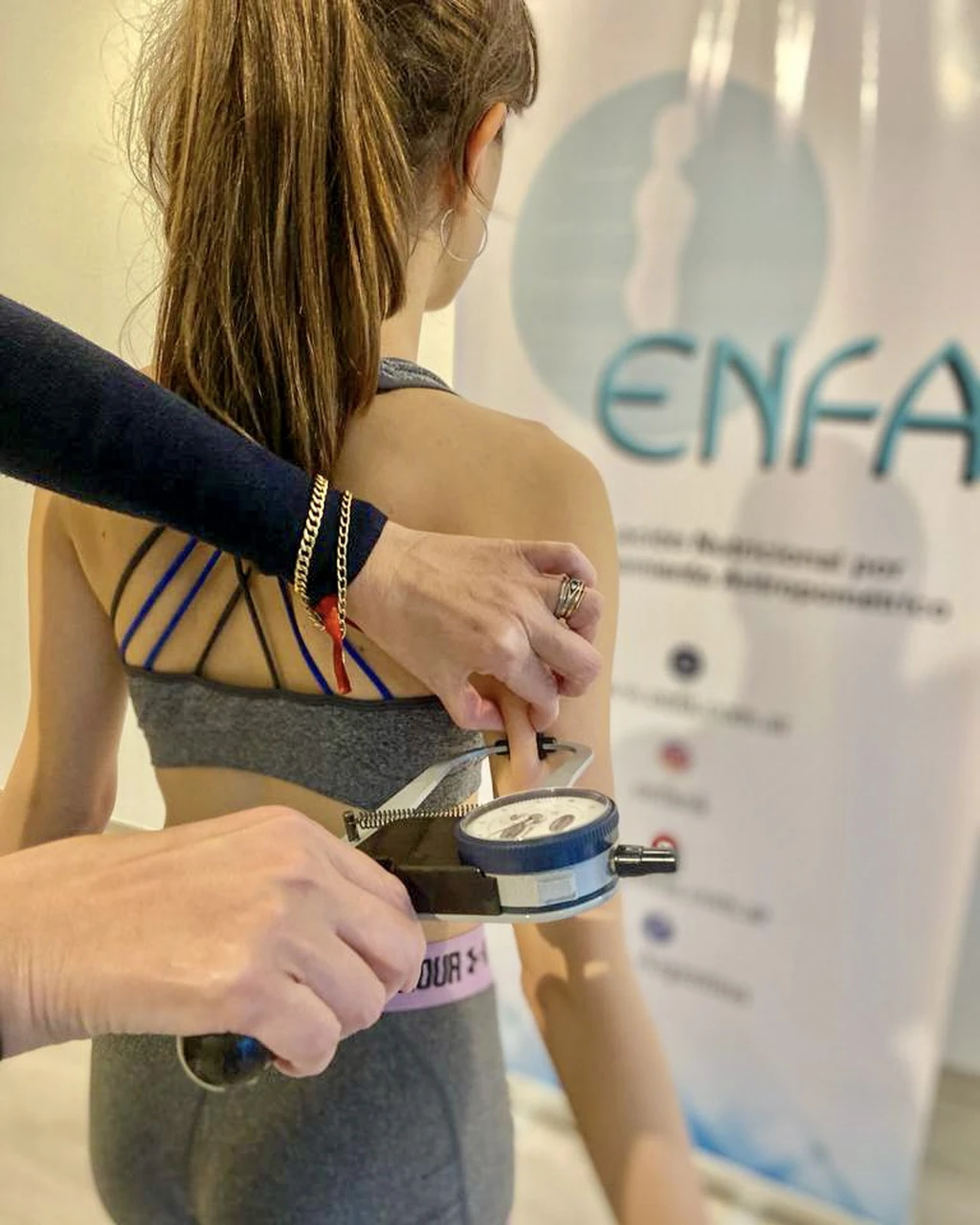
They make it possible to observe body fat distribution. It will be uniform as long as the Z values are “zero” or close to “zero”, revealing sites of greater fat accumulation as this value becomes positive.
Wrist and ankle breadths are especially important. A positive value for wrist breadth suggests that the individual has what it takes for sports such as tennis, apparatus gymnastics, weightlifting, boxing, etc., where having a strong wrist is important. Similarly, an ankle with a positive value shows strength for sports played with the feet, dance, etc.
In women, it is worth considering a positive biiliac and bitrochanteric breadth in relation to childbirth.
It is also common to see an increase in the anteroposterior breadth of the chest in individuals with obstructive lung disease.
Harmonious muscle development is one that shows a similar positive or negative z value in every measurement (all +2; or −2… When the value approaches “zero”, it should be interpreted that the individual has musculature in line with a sedentary population.
When one of the measurements shows positive values, it indicates that this muscle mass has been subject to greater work. Monitoring it makes it possible to advise the individual on the right activity or training for harmonious development or for a specific sport.
Weight, height or isolated measurements are not enough to carry out a Nutritional Assessment. Do you want to be innovative and specific in your practice? Apply the ENFA® method! The only method that determines a Nutritional Diagnosis and lets you define the specific nutritional therapy for your patient.